Multivariant strategic balance study — 2026-09-09
The map repair is complete; no experimental balance replacement is accepted. All authored maps now have exact rotational symmetry. The study completed 280,320 full-game executions, including 6,144 exact control/parity repeats, and a separate 153,600-exchange melee loadout audit. The strongest findings concern bot pathing, policy choice, melee opportunity counts and turn-order sensitivity. Permanent offensive Enraged remains the playable combat default.
The pool-minus-one plus ranged-accuracy-plus-two combination remains promising under the selected bot policies: melee payoff falls from 75.3% to 53.5% across its five opponents. However, every finalist candidate shows unresolved Causeway first-side sensitivity beyond the review margin. No candidate advances to the untouched holdout. This is a reviewed diagnosis, not a claim that the game is balanced or that the unrun full-panel confirmation would fail. Read the selection decision and independent final review.
Later owner adoption: after this study closed, the owner selected the ranged-accuracy-plus-two change by design decision, without the pool reduction, and separately replaced legacy climbs and falls with paid vertical movement. The original no-advancement study verdict and retained data remain unchanged. Its accuracy candidate ran under the old movement rules, so it does not validate or predict the combined live ruleset. See the adoption record and TASK-092.
All changes remain local on feature/local-playtest-prototype. Start a new match to use the repaired maps; existing saves retain their embedded board for replay consistency.
What is fixed in the actual maps
All four authored maps have exact 180° symmetry of resolved terrain, elevation, deployment areas and complete, non-overlapping objective footprints. Quarry terrain is now rotated correctly. Quarry, Foundry and Causeway have four paired seven-hex objectives; Flat remains an empty no-zone control. On the even-sized 32×20 hex board, the previous singleton central flower could not rotate onto itself. The current rules, Lite Rules and packet describe the four-zone layout.
The separate old/fixed diagnostic uses six same-roster mirrors, both first sides, 64 paired seed blocks, and all three objective maps: 4,608 games. This compares the combined terrain/objective repair, including three to four zones; it does not isolate terrain from scoring geometry.
| Map | Old physical-A payoff | Fixed physical-A payoff | Fixed first-side payoff |
|---|---|---|---|
| Quarry | 52.2% | 51.8% | 40.4% |
| Foundry | 51.4% | 50.1% | 45.4% |
| Causeway | 53.5% | 49.1% | 40.1% |
The geometry repair brings physical-end observations close to 50%; it does not remove the observed advantage of acting second. Causeway wipes fell from 83.3% to 64.8% in this mirror sample as objective opportunity increased. These are exploratory bot results, not universal human-side guarantees. Paired intervals and complete map diagnostic.
The pooled values also hide large family-specific shifts. In the 18-cell map-by-family stratification, Causeway armored physical-A payoff changed 77.3→43.8% and its first-side payoff 50.8→23.4%; Quarry mixed changed 51.6→60.2% physical-A and 46.9→33.6% first-side. These are paired 64-seed exploratory observations. Foundry melee’s 50% mirror payoff is entirely non-engaging draws: units move, but neither side attacks or scores. It is not evidence of healthy counterplay. The independent map review verifies the retained results and explains their limits. Exact map symmetry fixes a structural defect, but it does not guarantee family, activation-order or policy fairness.
Screening evidence
All 30 conditions cover 16 shared seed blocks, four maps, eight diagnostic roster pairings and all four roster-end/first-side assignments. The panel is incomplete and uneven across families, so its spread is a prioritization signal rather than a full-meta estimate. Draws score half. Selection is retained in the stage record.
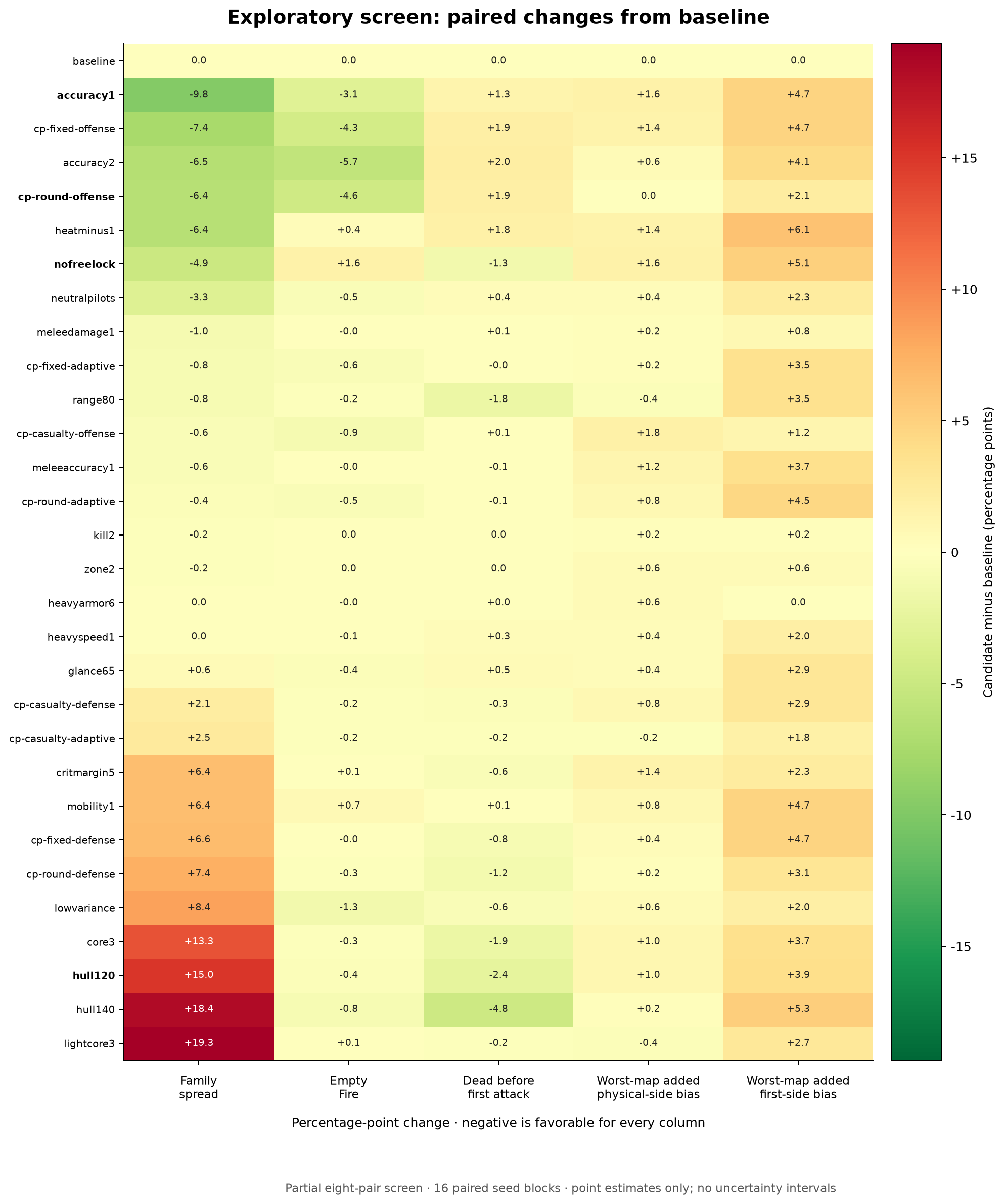
The most promising reliability mechanisms were ranged accuracy +1 and a replenishing offensive command reserve. Both reduced empty proactive Fires while increasing wipes and early deaths. Uniform Hull increases reduced early deaths but worsened the exploratory roster gap, motivating combinations rather than a blanket durability increase. Removing free Lock On sources exposed the contribution of unpriced support actions, but made attacks less reliable. Melee damage/accuracy buffs barely changed the large terrain-specific failures.
The command experiments use a shared team pool with fixed, equal-round or casualty income and offense, defense or adaptive automatic spending. These are nine distinct economy/policy conditions. Offensive CP buys one eligible failed offensive reroll; defensive CP reduces eligible incoming damage by one while preserving positive damage. Enraged has first claim on its own eligible reroll. Cap waste, declined spending, reserves, usage and nominal mitigation are retained. Human choice, bluffing and timing are not represented by the automatic policies, and nominal mitigation is not measured Hull saved.
Wide full-panel evidence
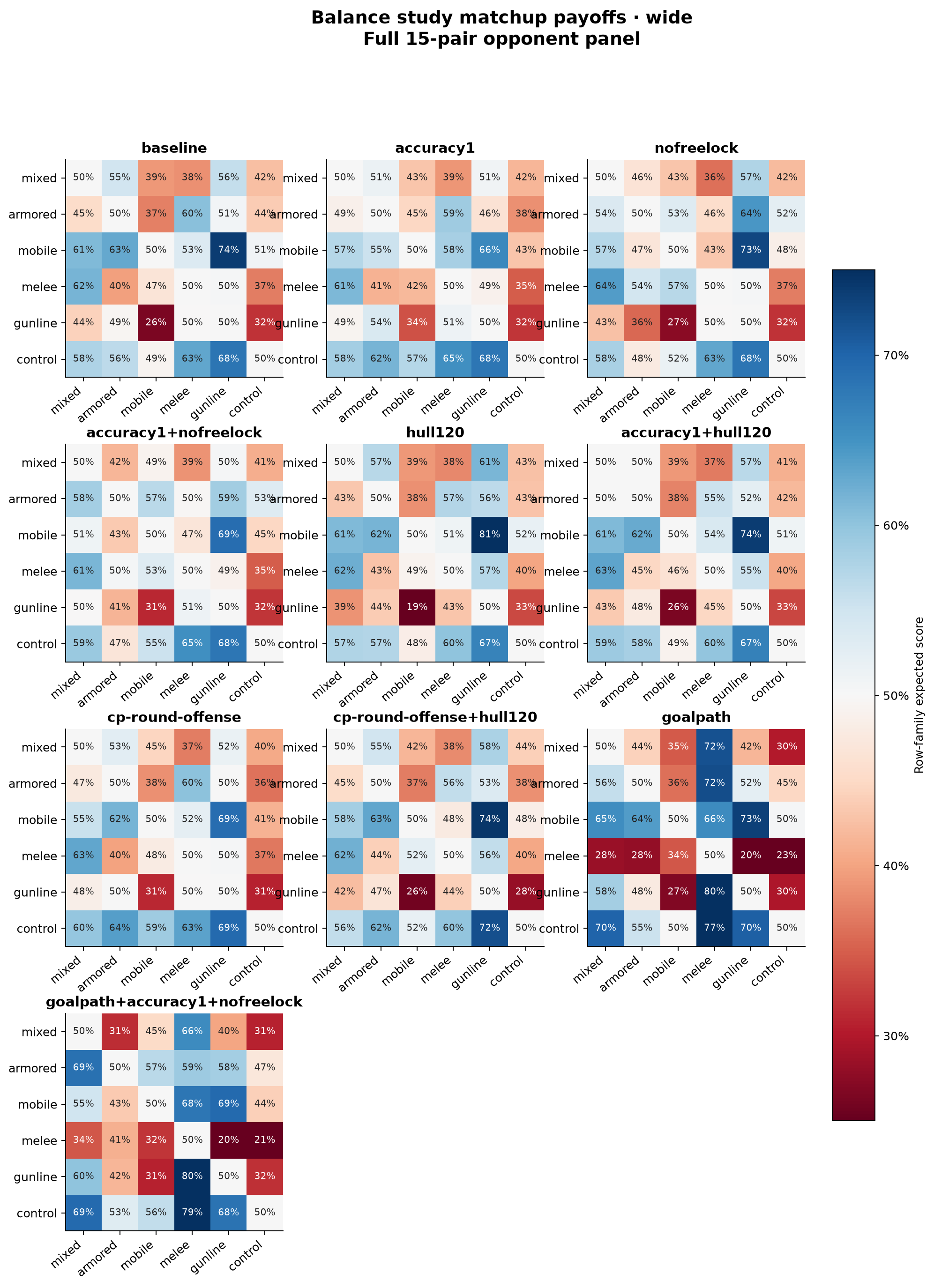
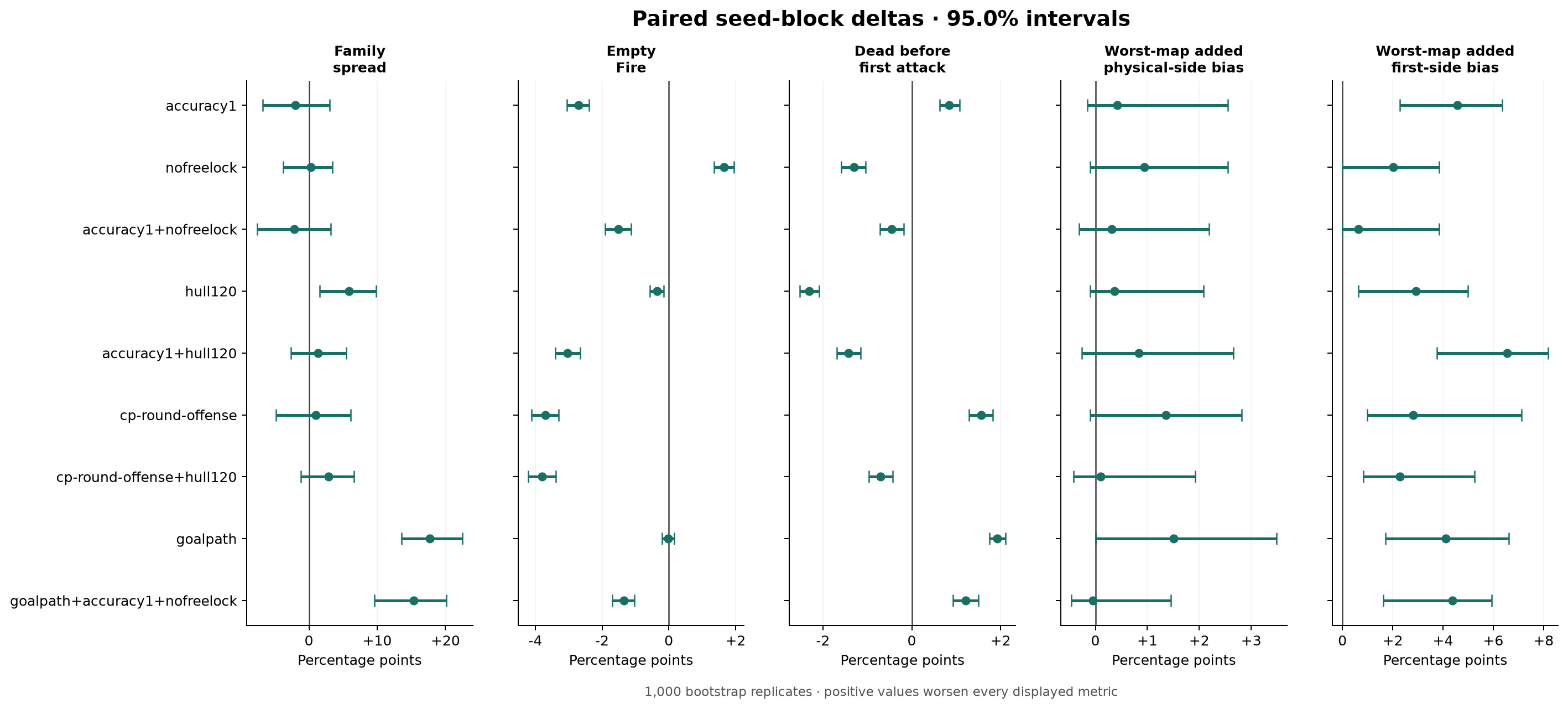
The completed wide stage contains 76,800 games: ten conditions, all 15 family pairings, four maps, all four roster-end/first-side assignments and 32 shared seed blocks. It uses equal map and opponent weighting. The 1,000-replicate 95% paired bootstrap intervals are exploratory; they are not the predeclared 5,000-replicate 99% confirmation intervals. Complete tables and intervals.
| Condition | Spread | Mean abs dev | Empty Fire | Dead before attack | Wipes | Rounds |
|---|---|---|---|---|---|---|
| baseline | 20.0% | 6.4% | 13.7% | 8.3% | 69.8% | 6.00 |
| accuracy1 | 18.0% | 6.0% | 11.0% | 9.2% | 72.9% | 5.93 |
| nofreelock | 20.2% | 5.9% | 15.4% | 7.0% | 69.1% | 6.04 |
| accuracy1+nofreelock | 17.8% | 5.1% | 12.2% | 7.9% | 71.3% | 5.97 |
| hull120 | 25.8% | 6.5% | 13.4% | 6.0% | 57.8% | 6.30 |
| accuracy1+hull120 | 21.3% | 6.3% | 10.7% | 6.9% | 61.1% | 6.27 |
| cp-round-offense | 20.9% | 6.3% | 10.0% | 9.9% | 76.2% | 5.80 |
| cp-round-offense+hull120 | 22.9% | 6.5% | 9.9% | 7.6% | 65.4% | 6.14 |
| goalpath | 37.7% | 10.1% | 13.7% | 10.3% | 64.6% | 6.14 |
| goalpath+accuracy1+nofreelock | 35.3% | 9.6% | 12.4% | 9.5% | 64.9% | 6.12 |
accuracy1+nofreelock had the smallest point spread and mean absolute deviation. Its paired spread change was −2.1 percentage points, with a wide 95% interval of [−7.6, +3.2]; it therefore does not establish a spread improvement. It reduced Empty Fire by 1.5 points [−1.9, −1.1] and early deaths by 0.5 points [−0.7, −0.2]. Accuracy alone reduced Empty Fire by 2.7 points but increased early deaths by 0.8 points and added 4.6 points of worst-map absolute first-side bias. Removing free Lock On alone moved those reliability and survival measures in the opposite directions.
Hull 120 reduced early deaths by 2.3 points and wipes by 12.0 points, but increased spread by 5.9 points [1.6, 9.8], driven especially by gunline falling to 35.5% and mobile rising to 61.3%. Offensive round CP reduced Empty Fire by 3.7 points while increasing early deaths by 1.6 points and wipes by 6.4 points. The Hull combination offset those lethality results: relative to baseline, cp-round-offense+hull120 reduced early deaths by 0.7 points and wipes by 4.4 points, but its spread was 2.9 points higher. It granted 11.07 CP per game, spent 7.48, wasted 1.21 at the cap and ended with 3.59; most spending occurred while scores were equal (4.63 per game), compared with 1.12 while behind and 1.73 while ahead. This automated policy leaves substantial reserves and cannot establish the value of human timing or comeback choice.
The complete component controls permit point-estimate interaction checks. Interaction here is combination − component A − component B + baseline; it is descriptive and has no interval in this stage.
| Combination | Spread interaction | Empty Fire interaction | Early-death interaction | Wipe interaction |
|---|---|---|---|---|
| accuracy1+nofreelock | −0.5 pp | −0.4 pp | +0.0 pp | −0.8 pp |
| accuracy1+hull120 | −2.6 pp | +0.0 pp | +0.0 pp | +0.2 pp |
| cp-round-offense+hull120 | −3.9 pp | +0.2 pp | +0.1 pp | +1.2 pp |
| goalpath+accuracy1+nofreelock | −0.2 pp | +0.2 pp | −0.3 pp | −1.1 pp |
The aggregate family scores conceal severe map matchups. In the baseline, gunline scored 26% into mobile and 32% into control after map averaging. On Foundry, melee scored 0% into control and gunline but 100% against mixed, armored and mobile. Flat reversed several of those relationships: armored and mixed scored only 2% and 3% into melee. Quarry melee scored 91% into control. All ten conditions retained extreme cells, so a moderate aggregate spread does not show uniformly healthy counterplay. Baseline physical-side absolute bias stayed at or below 1.3% on each map. Acting second led by 6.4 points on Causeway and 5.3 on Flat, while Foundry was nearly even; several attack-reliability candidates enlarged the worst-map first-side difference.
goalpath increased spread by 17.7 points [13.6, 22.5] and reduced melee's family payoff from 47.0% to 26.7% [25.2, 28.1]. Adding accuracy and removing free locks left melee at 29.8% [28.3, 31.3] and control at 65.1%. These are useful routing diagnostics: the known controller can enter safe-movement roof traps, and corrected distance direction alone does not preserve unreachable-route information. They do not show that human melee strategy has the same weakness, and they should not motivate compensating melee statistics before the safe-approach controls are measured.
The historical wide-stage shortlist was accuracy1+nofreelock, accuracy1, and cp-round-offense+hull120. They represent the best observed aggregate candidate, its attack-reliability component, and a distinct resource-plus-durability tradeoff. Retain nofreelock, cp-round-offense and hull120 as component controls for interaction interpretation. The reference and every candidate must use the same safe-approach controller. This shortlist is a measurement priority, not a promotion or final verdict.
Geometry and reachability controls
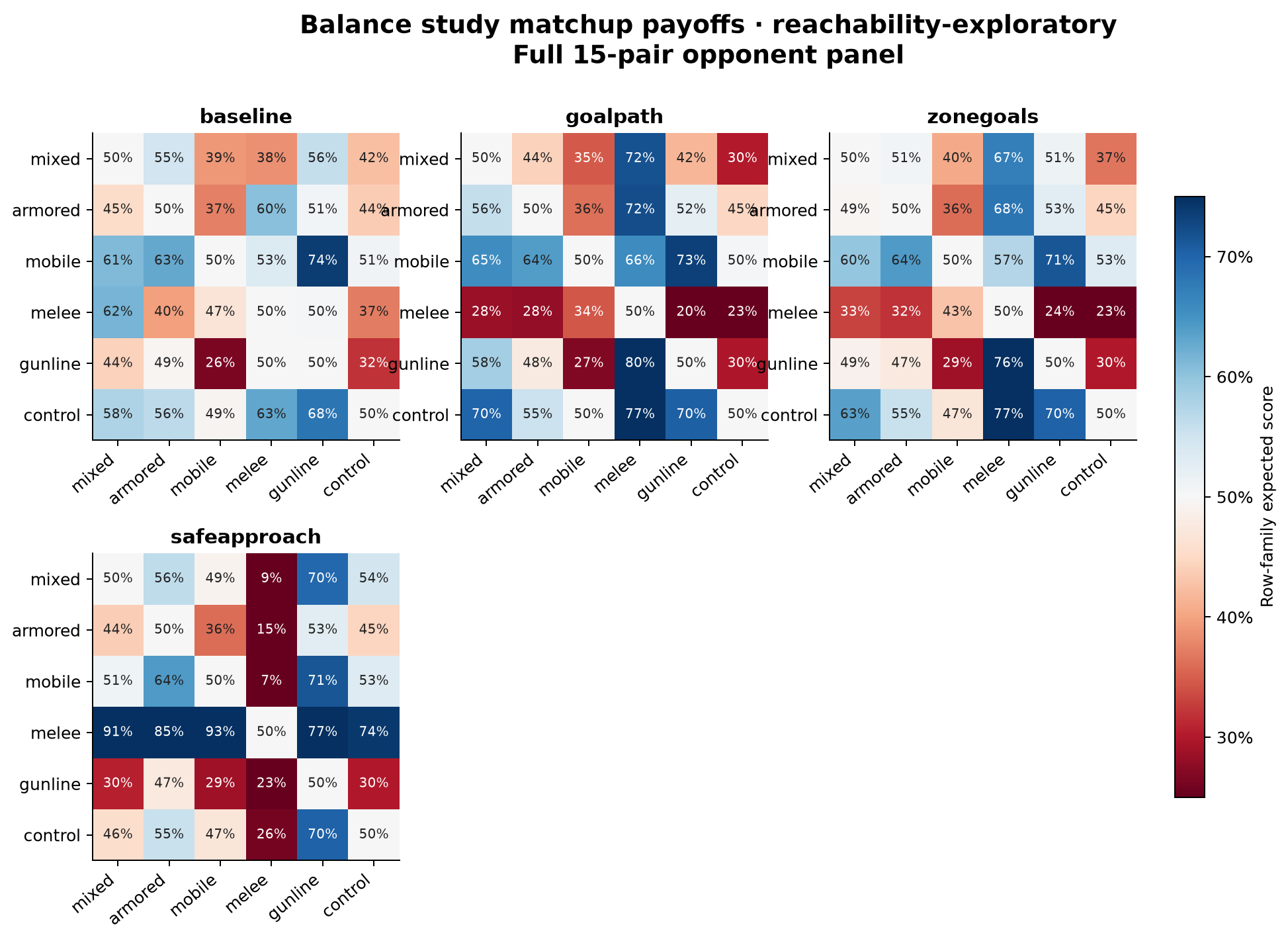
The completed reachability comparison separates four controller states across the same full 15-pair, four-map, 32-seed panel. baseline is the historical geometric policy. goalpath corrects distance-field direction. zonegoals also seeds every passable objective flower rather than only the center marker. safeapproach additionally preserves “goals exist but no safe route” with a finite board-bounded penalty. The immutable comparison reuses the original 7,680-row baseline and goalpath files after independent exact 2,048-row parity repeats for each, and adds complete 7,680-row zonegoals and safeapproach conditions. Source identities, phases and hashes remain visible; this is adaptive exploratory evidence.
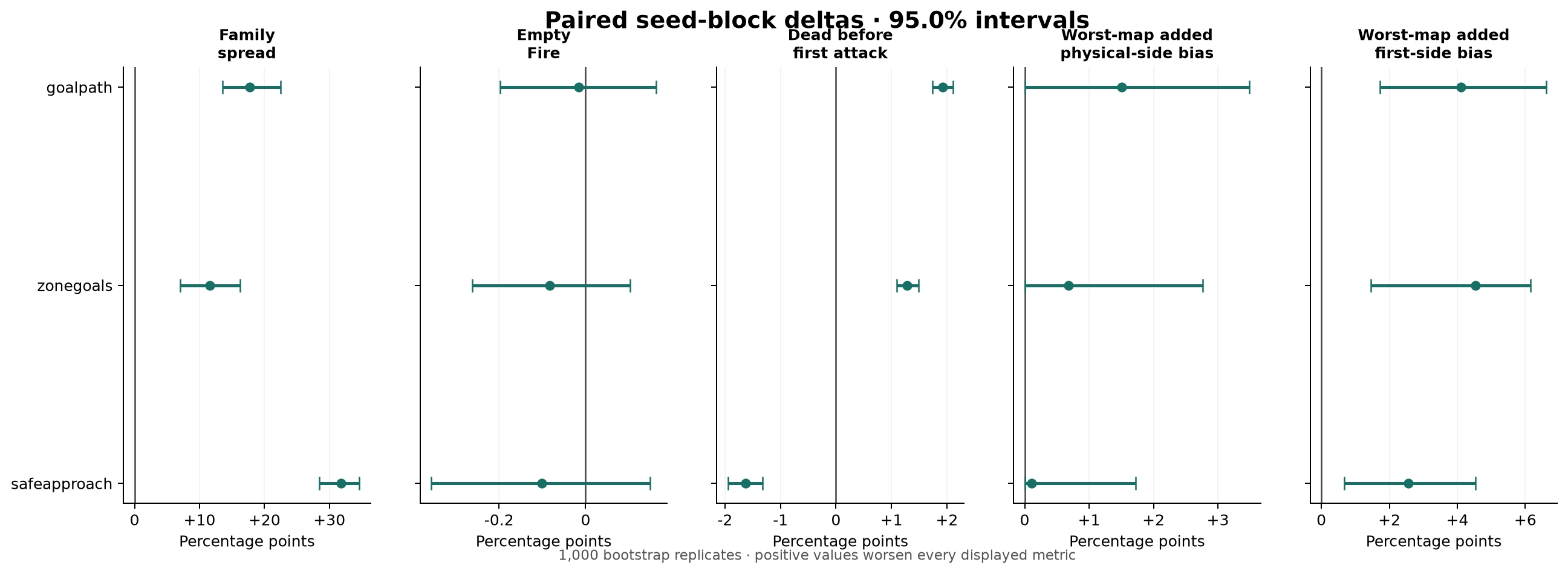
| Controller | Spread | Mean abs dev | Melee payoff | Gunline payoff | Early deaths | Wipes |
|---|---|---|---|---|---|---|
| baseline | 20.0% | 6.4% | 47.0% | 40.3% | 8.3% | 69.8% |
| goalpath | 37.7% | 10.1% | 26.7% | 48.6% | 10.3% | 64.6% |
| zonegoals | 31.5% | 7.9% | 31.0% | 46.1% | 9.6% | 65.5% |
| safeapproach | 51.8% | 11.2% | 83.7% | 32.0% | 6.7% | 82.1% |
Correct direction alone made the hidden routing problem more visible: relative to baseline, goalpath increased spread by 17.7 percentage points [13.6, 22.5] and moved melee from 47.0% to 26.7% [25.2, 28.1]. Using complete zone footprints recovered 4.3 points of melee payoff and reduced spread by 6.1 points relative to goalpath, but melee remained at 31.0% [29.4, 32.7]. The one-seed Foundry trace agrees with this mechanism: zonegoals still sent all three healthy Jump units onto the original roof component, where none had a safe route to a scoring flower.
Preserving unreachable-route information changed the outcome regime. Relative to zonegoals, safeapproach raised melee payoff by 52.7 points, lowered early deaths by 2.9 points, added 0.82 proactive melee starts per game and raised wipes by 16.6 points. In the retained Foundry mechanism trace, it chose ground routes, left every melee unit with safe paths to all four scoring flowers at round two, and produced scoring and proactive combat; zonegoals did neither. This supports the claimed routing mechanism.
The resulting 83.7% melee payoff [81.6, 85.6] is evidence that the old controller distorted the balance measurement, not evidence that human melee play is balanced. The old 47.0% average and 20.0-point family spread hid severe, opposing AI failures across maps and matchups. Once the known trap preference is removed, melee dominates this finite bot panel, gunline falls to 32.0% [29.1, 35.1], wipes rise to 82.1%, and overall spread reaches 51.8%. The corrected controller therefore invalidates promotion decisions based on the old aggregate ranking and requires the selected stat/resource candidates to be measured again against a common corrected reference.
All four controller states and their original outputs remain historical evidence. goalpath, zonegoals and safeapproach are explicit optional capabilities in saved configurations; none changes the ordinary gameplay default. The corrected-controller screen below uses the same safeapproach controller on both sides. This exploratory comparison supplies no human-balance proof or live-default change.
Corrected-controller screen
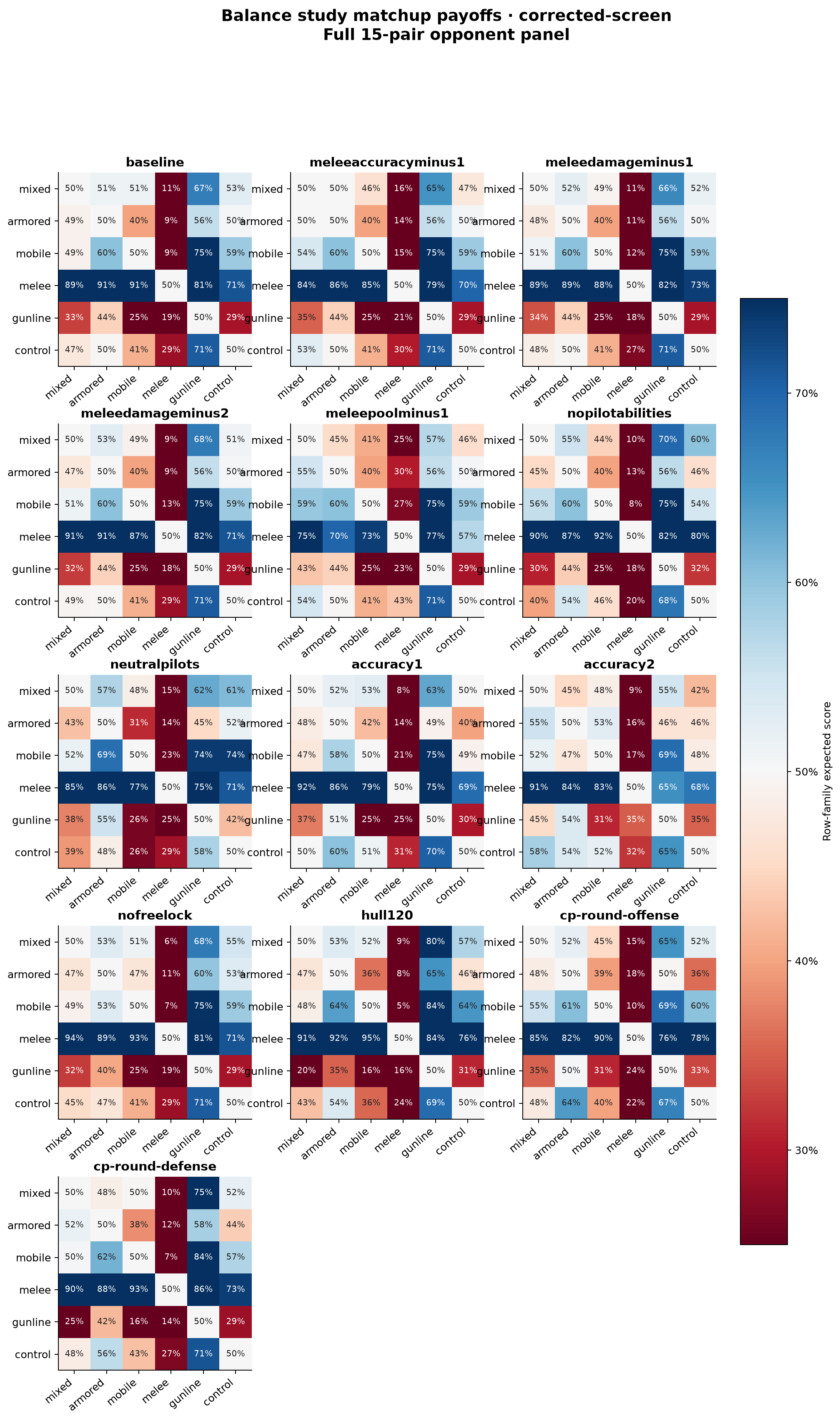
The completed corrected-screen analysis covers 13 conditions, all 15 family pairings, four maps, all four roster-end/first-side assignments and 16 shared seed blocks: 49,920 games. All 13 immutable output hashes match the execution log and are pinned in the comparison manifest. The 1,000-replicate 95% paired intervals are exploratory.
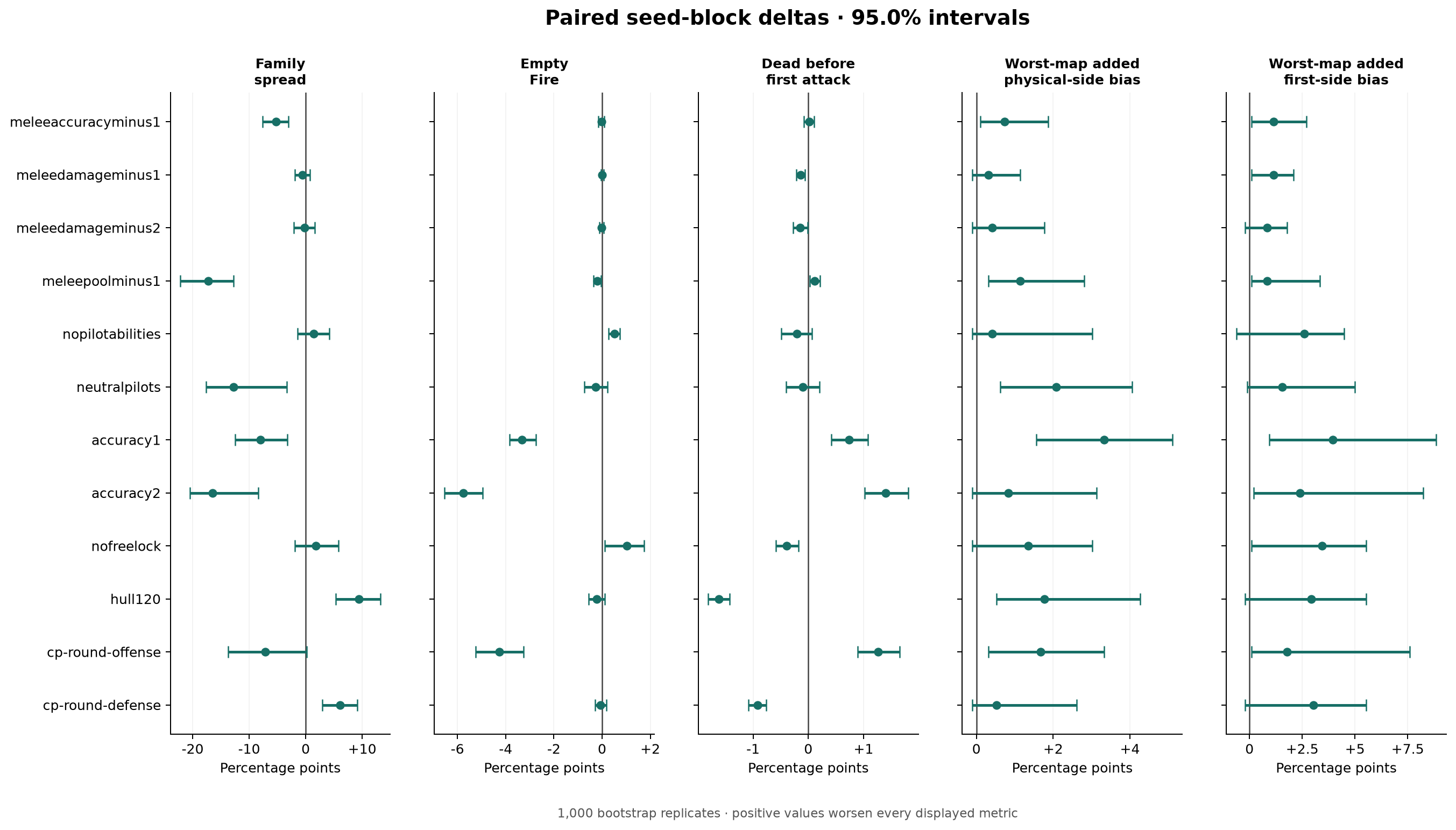
| Condition added to safeapproach | Spread | Spread change [95% interval] | Mean abs dev | Empty Fire | Early deaths | Wipes |
|---|---|---|---|---|---|---|
| baseline | 54.8% | — | 11.7% | 15.5% | 6.5% | 84.5% |
| melee accuracy −1 | 49.5% | −5.2 [−7.7, −3.0] pp | 11.1% | 15.5% | 6.5% | 84.3% |
| melee damage −1 | 54.2% | −0.5 [−2.0, +0.8] pp | 11.9% | 15.5% | 6.3% | 84.4% |
| melee damage −2 | 54.6% | −0.2 [−2.1, +1.6] pp | 12.0% | 15.5% | 6.3% | 84.7% |
| melee pool −1 | 37.5% | −17.3 [−22.2, −12.8] pp | 9.4% | 15.3% | 6.6% | 82.5% |
| no pilot abilities | 56.2% | +1.4 [−1.5, +4.2] pp | 12.3% | 16.0% | 6.3% | 83.8% |
| neutral pilots | 42.0% | −12.8 [−17.6, −3.4] pp | 12.3% | 15.2% | 6.4% | 76.3% |
| ranged accuracy +1 | 46.7% | −8.0 [−12.5, −3.2] pp | 10.9% | 12.2% | 7.2% | 85.3% |
| ranged accuracy +2 | 38.3% | −16.5 [−20.5, −8.4] pp | 10.1% | 9.7% | 7.9% | 87.0% |
| no free Lock On | 56.6% | +1.8 [−2.0, +5.8] pp | 11.9% | 16.5% | 6.1% | 83.0% |
| Hull ×1.20 | 64.1% | +9.4 [+5.3, +13.2] pp | 13.7% | 15.3% | 4.9% | 73.5% |
| offensive round CP | 47.6% | −7.2 [−13.8, +0.2] pp | 11.1% | 11.2% | 7.8% | 86.8% |
| defensive round CP | 60.9% | +6.1 [+3.0, +9.1] pp | 12.7% | 15.4% | 5.6% | 79.0% |
The corrected baseline confirms that safe routing exposed a large roster problem rather than solving balance: melee averaged 84.8% [82.0, 87.7] and gunline 30.0% [24.5, 35.9]. Melee's across-map matchups were 89% into mixed, 91% into armored and mobile, 81% into gunline and 71% into control. Individual map cells remained more extreme. For example, the baseline melee roster scored at least 90.6% against control on Causeway and Quarry and 100% against gunline on Foundry, while gunline scored 25% into mobile and 29% into control after map averaging. A lower aggregate spread therefore remains insufficient if extreme matchups persist.
Melee damage −1 and −2 barely changed spread or melee's family payoff. Accuracy −1 reduced spread by 5.2 points but left melee at 80.5%. Melee pool −1 was the strongest targeted single: spread fell 17.3 points, melee fell to 70.5% [66.9, 73.8], gunline rose to 33.0% [27.6, 38.8], and Empty Fire, early deaths and wipes moved by less than two points. It still leaves melee's interval wholly above the 65% review band and several extreme matchup cells.
Ranged accuracy +2 produced a similar spread reduction of 16.5 points and brought every family except melee inside the point-estimate review band; melee remained 78.1% [75.8, 80.5]. It reduced Empty Fire by 5.8 points while increasing early deaths by 1.4 points and wipes by 2.5 points. Accuracy +1 was a smaller version of the same tradeoff. Neutral pilots also reduced spread, but it simultaneously replaces all pilot stats, abilities and bonds, so it is a diagnostic of unpriced pilot power rather than a bounded rules finalist. Removing pilot abilities alone and removing free Lock On did not improve spread.
Every condition passed the four preregistered point-estimate guardrail margins: no more than +2 points Empty Fire, +5 early deaths, +5 worst-map added physical-side absolute bias and +5 worst-map added first-side absolute bias. This does not make the exploratory intervals confirmation tests. Accuracy +1's worst-map physical-bias interval reached +5.1 points and its first-side interval +8.9; accuracy +2's first-side interval reached +8.2. Map-level side effects must remain visible in the next stage.
Offensive round CP spent 6.76 of 10.30 granted points per game and ended with 3.54; it reduced Empty Fire by 4.3 points but increased early deaths by 1.3 and wipes by 2.3. Defensive CP spent 10.23 of 11.36, reported 10.23 nominal one-damage mitigations, reduced early deaths by 0.9 and wipes by 5.5, but widened spread by 6.1 points. These automatic policies show distinct reliability and survival effects, but they do not model human timing, bluffing or target choice.
The complete corrected screen selected melee pool −1 and ranged accuracy +2 for the focused policy comparison below. They produced the two largest targeted spread reductions through different mechanisms. The four-condition design retains the safeapproach control, both singles and their combination to expose complementarity or overshoot. This exploratory selection did not accept a live rule or a holdout finalist.
Cautious-policy grid
The approved four-condition grid completed 64,000 games with zero failures or resumed conditions and matching frozen inputs. Each condition crosses five melee-involving pairings, four maps, eight seed blocks, all four roster-end/first-side assignments and every combination of aggression 0, 0.25, 0.5, 0.75 and 1. All four immutable output hashes are pinned in the comparison manifest, and the paired analysis uses 1,000 exploratory 95% seed-block bootstrap replicates.
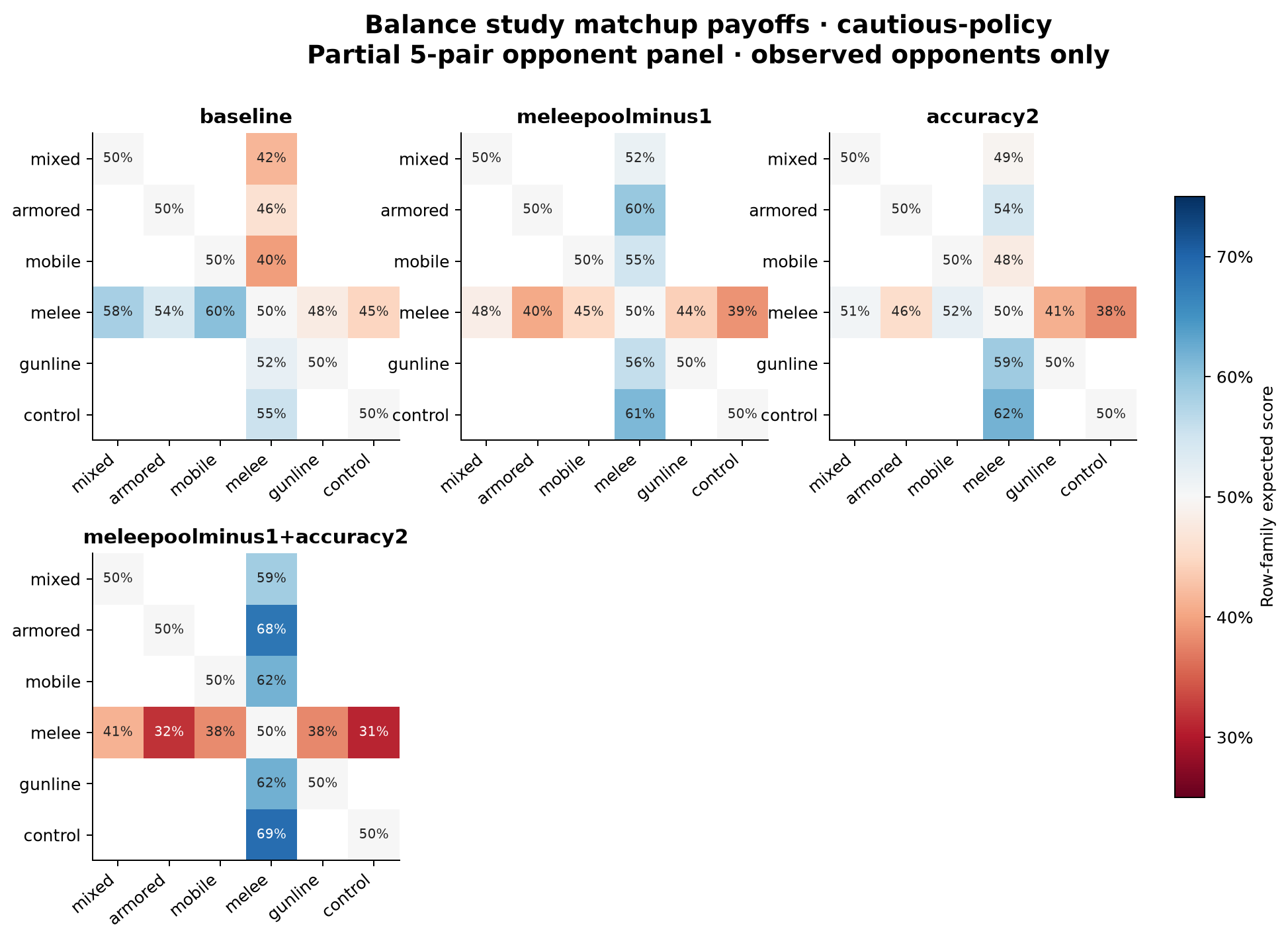
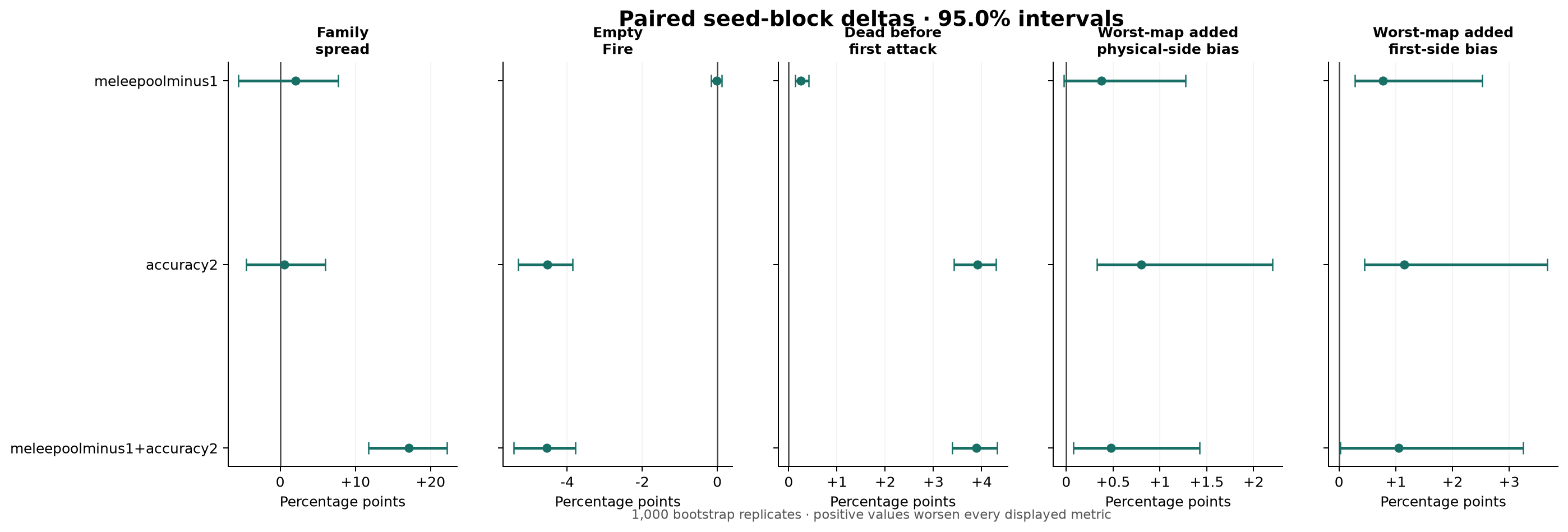
This is a partial five-pair panel. Each non-melee family is observed only against melee, and every policy cell is pooled equally in the table below. “Observed spread” is the range across those partial-panel payoffs; it is not a global six-family spread estimate and cannot select a policy profile.
| Condition | Observed spread | Melee payoff across five opponents | Mixed vs melee | Armored vs melee | Mobile vs melee | Gunline vs melee | Control vs melee | Empty Fire | Early deaths | Wipes |
|---|---|---|---|---|---|---|---|---|---|---|
| baseline | 15.8% | 53.0% | 41.8% | 46.2% | 39.6% | 52.0% | 55.4% | 11.8% | 22.4% | 68.9% |
| melee pool −1 | 17.9% | 43.3% | 51.7% | 59.6% | 55.0% | 56.0% | 61.2% | 11.7% | 22.7% | 65.0% |
| ranged accuracy +2 | 16.4% | 45.5% | 49.2% | 54.4% | 48.0% | 58.8% | 61.9% | 7.2% | 26.3% | 75.4% |
| both changes | 32.9% | 36.1% | 58.7% | 68.0% | 61.9% | 62.1% | 69.0% | 7.2% | 26.3% | 73.4% |
Policy pooling changes the picture from the fixed 0.75 corrected screen. On the same eight fresh seeds, baseline melee payoff is 85.6% at fixed 0.75/0.75, 81.3% when pooling only the old 0.5/0.75/1 grid, and 53.0% when pooling all five levels. This matched comparison demonstrates that bot policy can dominate a balance reading; none of these equal mixtures is a strategic equilibrium. Each single reverses the pooled advantage moderately. Their combination overshoots: melee falls to 36.1%, armored and control score 68.0% and 69.0% against it, and observed spread rises by 17.1 points [11.8, 22.2] from baseline. Combination interactions are evaluated on matched payoff cells in the policy diagnostic; spread is nonlinear and is not used as an additive mechanism measure.
All three candidate conditions remain within the four point-estimate guardrail margins on this partial panel. Accuracy +2 and the combination reduce Empty Fire by about 4.5 points while increasing early deaths by 3.9 points; the combination raises wipes by 4.5 points. Melee pool −1 changes Empty Fire negligibly, raises early deaths by 0.3 points and lowers wipes by 3.9 points. These pooled point checks do not replace map-level review or confirmation intervals.
The completed policy diagnostic selects one common profile from control alone. Non-melee families select aggression 0/0.25 in 18 of 20 map/pair cells and 0.5 in two; melee selects 0.75/1 throughout. Each condition has 640 observations at that shared profile. These are selected training data, not confirmation. The retained full profile marks 40 other map/pair cells as untrained 0.75/0.75 fallbacks.
| Shared control-selected profile | Control | Pool −1 | Accuracy +2 | Both |
|---|---|---|---|---|
| Melee payoff across five opponents | 75.3% | 66.4% | 69.1% | 53.5% |
| Empty proactive Fires, equal map weighting | 13.37% | 13.27% | 9.06% | 8.69% |
| Deaths before a proactive attack | 15.39% | 15.52% | 18.05% | 17.71% |
| Games ending in a wipe | 67.97% | 58.13% | 72.81% | 66.56% |
| Causeway first-side payoff | 50.00% | 40.63% | 39.38% | 36.88% |
The selected-profile combination is promising rather than a general overshoot. It still has uneven matchups: melee scores 68.8% into mixed, 38.3% into armored, 36.3% into mobile, 68.0% into gunline and 56.3% into control. Its matched melee-oriented payoff interaction is −6.64 points beyond the sum of the singles, a descriptive selected-training contrast. Joint leave-one-seed policy agreement ranges from 37.5% to 100%; the Quarry mobile cell has a 25-point pure response gap. Pure security choices are not necessarily an equilibrium.
The new exchange observer also exposes a play-feel cost that ranged Fire metrics miss. Among completed exchanges at the shared profile, the initiating side deals zero body damage in 21.4% of control exchanges, 32.3% with pool minus one and 33.8% with the combination. Mean initiating body damage falls from 7.87 to 6.15 and 6.06 respectively, while exchanges per game rise from 3.16 to 3.67 and 3.44. These initiator-role observations combine all families and changing combat situations; they are not a matched isolated weapon effect. They show why a pool reduction needs direct melee review even when aggregate ranged reliability improves.
The unresolved selection concern is Causeway: the added absolute first-side bias is 9.4 points for pool minus one, 10.6 for accuracy plus two and 13.1 for both, above the five-point review margin. The combination’s empty-Fire and early-death point results are acceptable, but those benefits do not resolve the turn-order concern. The broad conditional intervals also do not rule out harmful bias. These five-pair observations do not prove failure of the unrun full-15 confirmation, whose opponent weighting differs. They support the reviewed decision to advance no finalist while preserving the combination as a scoped future candidate.
Power budget and simulation limits
The exact roster audit enumerates 5,940 ranged situations and 90 initial melee matchups. It identifies distinct offense, survival, mobility, exchange-control and team-utility axes. Three Couriers use only 99/145 team weight but almost fill their individual chassis caps; they combine Evasion 14–15, Speed 6 and three free Lock On sources. The gunline has stronger common-target printed shooting and more Hull. Unspent team weight cannot simply become extra equipment without violating personal caps. The six concrete rosters do not represent optimized archetypes or every ability synergy; only the melee roster enables special pilot abilities.
The separate melee loadout audit executes 153,600 fresh adjacent exchanges, not full games. Across five legal held-loadouts, three pilots, five stock targets and both initiating roles, dual Spike is lighter than dual Blade (44 versus 46 total build weight) and carries two additional melee opportunities. With equal pilot/target/initiator weighting, its one-exchange enemy-kill probability is 82.8% versus Blade’s 75.7%. Pool minus one lowers these to 62.6% and 46.3%, widening that gap. This contact-only result does not establish global dominance, but it identifies a concrete weakness in pricing and in the full-game panel, which fields only Blade melee rosters. A precise result for those six rosters would miss the alternative loadout.
Official competitive-game research supports using several controls together: roster budgets and composition restrictions, limited shared resources, access/action costs, scenario design and empirical adjustments. These are design patterns, not a transferable single formula for pricing mech parts.
The goal-path diagnostic confirmed that the bot used distance-from-goals as distance-to-goals despite directional climbs and terrain entry costs. The optional correction passed independent review, 498 full-suite tests and typecheck; its 2,048 repeated baseline rows exactly match the original screen. But its paired candidate did not fix Foundry's melee failures and worsened the exploratory gap. Further traces identify roof traps: healthy Jump units can climb onto a connected roof but cannot leave through safe movement, while the bot excludes falls and substitutes geometric distance for an absent route. Quarry also contains valid scoring flowers with blocked centers, which center-only objective goals misrepresent. These are planning defects requiring separate controlled treatment before interpreting stat changes as strategic balance.
Reproduction and acceptance
The protocol freezes practical targets, primary guardrails and seed-block pairing. Each simulation phase retains exact commands, complete catalogs/rules/rosters/maps, source hashes, immutable outputs and execution logs under the evidence directory. The runner refuses incomplete factorial outputs and source drift. Analyzer tests reject incomplete confirmation grids, and independent review checked pairing, weighting, bootstrap and baseline-trained policy locking.
The final selection record is written before any final-range data are accessed. No holdout or additional tuning ladder was launched. Independent review accepts the retained measurements and the bounded diagnosis; it does not certify the game, catalog or human strategy balance.
Full verification passed 536 Vitest tests across 77 files and TypeScript checks. Map symmetry and packet routes have additional focused verification; Python analyzers validate exact pairing and grid completeness. At study close, the current rules, Lite Rules, GDD and simulator specification described the map repair while experimental CP, routing and stat candidates remained separate. The later adoption note above records the owner's subsequent ranged Accuracy decision without rewriting this evidence.
The next useful work is to explain Causeway activation-order sensitivity, improve threat-aware bot choices, and expand legal loadout/pilot coverage before choosing another candidate. Raw damage alone is a weak answer to the observed melee advantage: opportunities govern both striking and parrying, while mobility and range management determine whether those opportunities occur at all.