Post-adoption balance checks and real-item pricing — 2026-09-09
The retained evidence and independent review are complete. The playable catalog and rules remain unchanged. This study measures the adopted ranged Accuracy +2 and paid vertical movement, then asks how to price future parts and weapons without rewarding one universally superior package.
Scope
The prospective protocol fixes 15,360 factorial games and 768 separate current-rule mirrors. Four conditions separate old/new ranged Accuracy and legacy/paid movement. All other rules, legal roster builds, maps and pilots are held fixed. The primary panel uses .75/.75 aggression; transferred historical policies are a separate sensitivity panel, not optimized current counterplay. Each full panel has eight shared seed blocks, not thousands of independent samples.
Separate evidence contains 1,440 exact standard-weapon marginal rows, 120 initial melee budgets, 9,216 passive-target firing sequences, and 2,136 deterministic mobility rows. The isolated checks explain mechanisms; they cannot establish full-game balance or finalized prices. No live changes follow automatically.
Full-game result: reliability improves, balance is not certified
The fixed .75/.75 panel has 1,920 games per condition and eight shared seed blocks. Payoff counts a draw as half a win. Family payoff equally weights maps and opposing families. Empty proactive Fires and wipe terminations pool the complete condition panel. Exploratory 95% intervals resample the eight whole seed blocks 1,000 times.
| Condition | Melee family payoff | Gunline family payoff | Empty proactive Fires | Games ending by wipe |
|---|---|---|---|---|
| Pre-adoption | 44.2% | 37.2% | 14.7% | 70.8% |
| Accuracy only | 43.3% | 44.8% | 9.8% | 77.0% |
| Movement only | 84.2% | 27.7% | 14.3% | 81.5% |
| Current adopted rules | 77.3% | 39.5% | 9.1% | 86.9% |
Accuracy +2 improves proactive-Fire reliability in this panel. Empty proactive Fires fall under both movement conditions. Accuracy also moderates the melee advantage under paid movement, while wipes increase.
From pre-adoption to current, melee payoff rises by 33.1 points [28.0, 38.8]. This comparison measures the adopted bundle. It does not assign the change to one rule.
Across both movement conditions, Accuracy reduces zero-body-damage proactive Fires by 0.86 per game. Its 95% interval is 0.71 to 1.00 fewer. It changes melee payoff by −3.9 points [−7.7, −0.1] and gunline payoff by +9.8 [6.6, 11.8]. It also raises wipe termination by 5.8 points [4.5, 7.1].
The movement factor produces the larger roster shift under these fixed policies. It changes ordinary elevation costs and the Jump elevation waiver. It also removes climbing Heat and fall consequences. The panel cannot attribute that shift to Speed or one movement rule.
Across both Accuracy conditions, the movement bundle changes melee payoff by +37.0 points [34.8, 39.8]. It changes gunline payoff by −7.4 points [−10.9, −4.2]. Wipe termination rises by 10.3 points [8.6, 11.7]. The Accuracy and movement interaction changes melee payoff by −5.9 points [−10.8, −0.9].
Current fixed-policy family payoff remains uneven:
| Current family | Payoff [95% interval] |
|---|---|
| Mixed | 45.3% [41.9, 48.9] |
| Armored | 34.5% [31.4, 37.8] |
| Mobile | 48.8% [43.4, 53.1] |
| Melee | 77.3% [75.2, 79.5] |
| Gunline | 39.5% [34.8, 45.0] |
| Control | 54.5% [51.3, 58.0] |
The current condition ends by wipe in 86.9% of games, up from 70.8%. The paired change is +16.1 points [13.6, 18.3]. Mean deaths rise from 3.73 to 4.13, a change of +0.39 [0.35, 0.44]. Five units die in 28.6% of current games, versus 17.8% before adoption. Eleven pre-adoption games have no death; no current game does.
A first death occurs by round 2 in 58.9% of current games, versus 48.0%. Mean length falls by 0.39 rounds [0.34, 0.45 fewer]. Death before a unit's first proactive attack stays 7.9% to 7.8%. Its paired interval [−1.0, +0.7] includes no change.
The first-loss side wins 29.8% before adoption and 37.7% under current rules. The counts are 568 of 1,909 and 724 of 1,920. This is a descriptive association. It does not show that wipes make the first kill less decisive. It does not identify Enraged as the cause.
The transferred-policy sensitivity keeps the same main pattern. Pre-adoption to current melee payoff changes 40.8% to 73.6%, or +32.8 points [29.4, 35.8]. Empty proactive Fires change 14.8% to 9.5%, or −5.3 points [−6.6, −4.0]. Wipes change 65.8% to 79.8%, or +14.1 points [12.0, 15.7]. Current gunline payoff is 38.4%. This profile transfers 20 trained cells and uses .75/.75 fallbacks for 40 cells. It is not optimized for the current rules.
Its pre-adoption and Accuracy-only conditions each have 64 no-engagement games of 1,920. All occur on Foundry in melee against gunline or control. Movement-only and current have none. Every factorial panel has zero draws.
Current fixed games give physical Side A 50.3% payoff and the first side 45.2%. The 768 fresh current mirrors give physical Side A 49.2% and the first side 45.3%. Draws and no-engagement games are 0% in both panels.
| Fresh current mirror map | First-side payoff |
|---|---|
| Flat | 38.5% |
| Quarry | 54.2% |
| Foundry | 46.4% |
| Causeway | 42.2% |
Exact rotational geometry does not guarantee first-activation fairness. Check initiative and matchup context before finalizing prices.
These policies are not optimized current counterplay or a human equilibrium. Both full-game profiles remain provisional for pricing. Retain the adopted rules for now. Do not apply another global Accuracy increase from this evidence. Test access, mission pressure and current-policy counterplay before further global melee or Accuracy tuning.
What helps design parts and weapons now
Start each item with a role, its best context and a useful weakness. Price the complete legal package against its closest legal alternative. Budget access, reach, survival and actions with the attack payload. Expected damage is one screening outcome. It is not universal power.
| Check | Practical threshold | Limit |
|---|---|---|
| +1 Accuracy | Rifle against Courier rises from 60% to 65% hit chance. Rifle against Bastion stays at the 95% ceiling. | Cover and movement can move the same weapon away from the ceiling. |
| +1 Pen | Cannon gains no printed damage against clear Courier. It rises from 8.163 to 8.920 expected printed damage against Bastion. | Critical effects and finite Durability are outside this exact check. |
| Piloting 1 to 2 | Ruko's dual Blade pool rises from six to seven dice. Successful offensive opportunities rise from 3.00 to 3.85 against Courier. | This step also changes first-spend order when Ruko initiates. |
| Piloting 2 to 3 | Marrow keeps seven dual Blade dice. Successful opportunities rise from 3.85 to 4.20 against Courier. | This step changes first-spend order when Marrow defends. |
| Arm package | +1 Handling on the right arm adds one die. +1 pool die on each held weapon adds two dice to a dual loadout. | Name the affected arm or weapon. Do not price these effects as the same unit. |
| Heat | Reducing Heat from one to zero removes Vent pressure in the declared passive sequences. | The samples do not demonstrate a kill-rate gain or another useful attack. |
| Jump | Jump waives elevation cost and opens routes or firing positions at specific allowances. | It is not a constant Speed bonus. Weight, Armor and Durability still apply. |
Use four tests for the next real item set:
- Compare the fastest legal melee packages with ranged disengagement, screens and Overwatch choices.
- Measure contact timing, exposure, firing access, initiative and scoring by map.
- Compare equal-role ranged packages at retained Accuracy. Require a meaningful reliability, damage or Heat tradeoff.
- Test the strongest legal package around each relevant breakpoint. Include Pen, Piloting, movement allowance, capacity and Weight.
These are next measurements. They do not approve a catalog or rules change.
Mobility buys access, not a constant amount of power
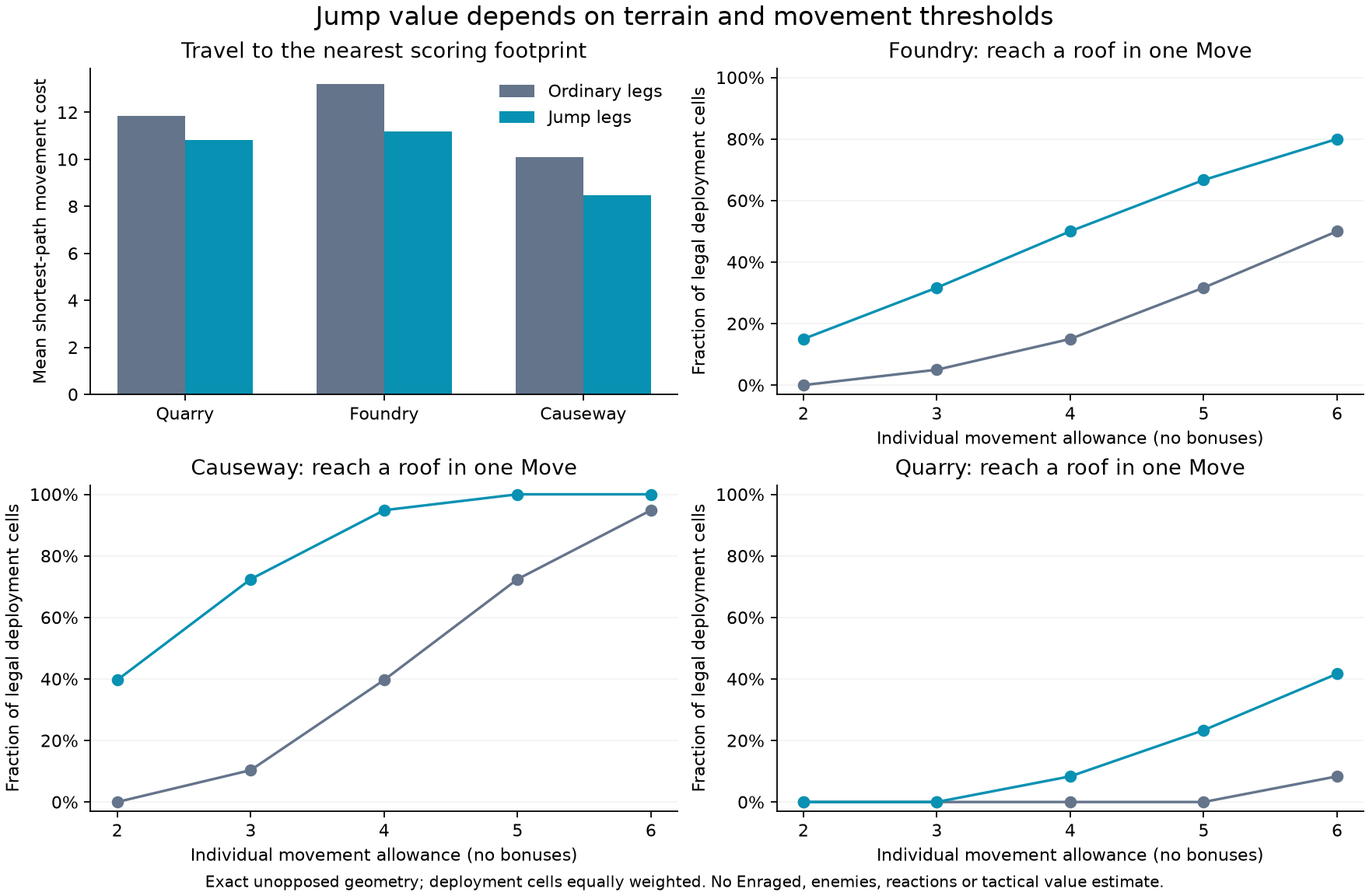
Across every legal deployment cell on both physical ends, the shortest unopposed route to the nearest scoring footprint has these mean movement-point costs:
| Map | Ordinary legs | Working Jump legs | Jump saving |
|---|---|---|---|
| Quarry | 11.83 | 10.83 | 1.00 |
| Foundry | 13.22 | 11.18 | 2.03 |
| Causeway | 10.10 | 8.48 | 1.62 |
These are route costs, not arrival activations. Move and Boost have separate allowances; unused movement cannot simply be banked. The audit's multi-activation totals are explicitly optimistic lower bounds and exclude edges no individual allowance can pay.
The stronger breakpoint is roof access. With each movement allowance capped at 2, ordinary legs cannot enter any roof on Foundry or Causeway, because the available entry edges cost more than that allowance. Jump legs can. This is not an absolute restriction on a printed Speed 2 mech: active Enraged adds two points to ordinary movement and can change the result. At a fixed allowance of 4, a roof is reachable in one Move from 50% of Foundry deployments with Jump versus 15% with ordinary legs; on Causeway the figures are 94.8% versus 39.7%.
Price a mobility part for the routes, firing positions and actions it enables on the declared map pool. Do not give Jump a universal equivalent of “+1 Speed.” Its current comparison with Standard legs also has real drawbacks: one more Weight, one less Legs Armor and two less Legs durability. The geometry audit isolates movement capability; it does not erase those defensive costs or certify either part as superior.
All 2,136 rows obey exact rotation pairing. The audit independently cross-checks 216 raw shortest paths against Board.reachable; a separate reviewer checked all 21,360 row/budget/leg-mode single-Move predicates. Flat has no objectives and is excluded from objective-access denominators. Retained mobility data.
Weapon stat points are not interchangeable
The isolated marginal audit uses legal shared test platforms and retains each target/cover/movement cell. Its exact calculation includes printed hit, penetration and damage distributions; it excludes critical-table extras, Heat damage, finite target durability and future actions. The numbers below equally average five targets, three covers and two movement contexts.
| Weapon | +1 Accuracy | +1 Pen | +1 damage per projectile | +1 projectile |
|---|---|---|---|---|
| Rifle | +0.24 | +0.36 | +1.03 | +1.75 |
| Autocannon | +0.32 | +0.55 | +1.30 | +1.44 |
| Cannon | +0.44 | +0.21 | +1.43 | +1.65 |
| Pulse | +0.10 | +0.23 | +0.99 | +0.71 |
| Lance | +0.34 | +0.36 | +1.12 | +2.49 |
Entries are additional expected printed body damage per Fire, not price suggestions. Each change leaves other attributes fixed to measure its marginal benefit. A real item needs a corresponding cost or drawback.
An extra projectile repeats the weapon's payload, so its value depends on that payload. A flat damage bonus applies to every projectile and interacts with rounded glances. Accuracy reaches the natural-1 ceiling in some contexts. Pen can stop adding printed damage against already penetrable armor, but may still improve critical effects omitted by this table. Those are different breakpoints and cannot share one universal cost per stat point.
Heat requires a separate action-economy measurement. The immediate printed-damage audit correctly assigns Heat reduction no immediate damage benefit; the persistent engine sequences measure stress and Vent use instead. Those sequences use passive targets, at most eight firing activations, and declared automatic cooling policies. Their saved Vents are opportunities for other actions, not a measured number of extra attacks or objective points. See the full appendix for kill, self-death and surviving-horizon censoring.
A reusable process for real parts and weapons
For each proposed item, keep a short role statement and a measurable tradeoff. Then evaluate it in this order:
- Check legality and categorical differences. Include individual chassis cap, arm capacity, held Weight, two-handed occupancy, ammunition Weight/use limits, support abilities and pilot interactions. A Precision arm cannot carry an Autocannon merely because its handling-to-weight ratio looks good. Unused team Weight does not bypass an individual cap.
- Measure an outcome vector. Record hit reliability, empty attacks, actual damage, disable/kill probability, Heat and actions consumed, survival, range and movement access. For melee, track usable opportunities and initiative as well as damage; spending a die to parry removes an attack opportunity.
- Test thresholds and combinations. Include armored/evasive targets, cover, wounded states, different pilots, and the maps/mission pool. Check one point on either side of movement, penetration, capacity and Piloting thresholds. Price the complete weapon/arm/pilot package as well as its components.
- Compare legal whole-build substitutions. An item should improve its intended role while surrendering useful performance elsewhere. Reject a genuinely dominated item, but do not mistake differences in unmeasured abilities or ammunition for proof of dominance. The current conservative body check found no confirmed same-context dominance; that does not establish optimal pricing.
- Use game and human results to calibrate costs. Isolated performance provides candidate ranges and explains failures. Map-specific matchups, action use and human counterplay determine whether those tradeoffs matter. Retain the original tests as regression checks when real content replaces the demo catalog.
Use the reusable item worksheet to record those decisions for each real part or weapon. It retains separate outcomes rather than a single uncalibrated power score. A part can be efficient at its role without being the best choice on every mech.
Retained evidence and reproduction
The study ran from a worktree based on commit 460abb237e44b582daae2dfa30999d81a29d40dc. Each manifest pins the exact changed source and input hashes used by its audit.
pnpm exec tsx cli/post-adoption-balance.ts --manifest docs/tuning/evidence/2026-09-09-post-adoption/post-adoption-manifest.json --out docs/tuning/evidence/2026-09-09-post-adoption/fullgame/post-adoption-results.json --execute --freeze-approved
python3 cli/post-adoption-summary.py --input docs/tuning/evidence/2026-09-09-post-adoption/fullgame/post-adoption-results.json --validation docs/tuning/evidence/2026-09-09-post-adoption/fullgame/post-adoption-validation.json --out docs/tuning/evidence/2026-09-09-post-adoption/fullgame/post-adoption-summary.json --bootstrap 1000 --bootstrap-seed 20260909
pnpm exec tsx cli/post-adoption-mobility.ts docs/tuning/evidence/2026-09-09-post-adoption/mobility.json
pnpm exec tsx cli/part-marginals.ts --prepare --out docs/tuning/evidence/2026-09-09-post-adoption/marginals/manifest-v2.json
pnpm exec tsx cli/part-marginals.ts --run --manifest docs/tuning/evidence/2026-09-09-post-adoption/marginals/manifest-v2.json --out docs/tuning/evidence/2026-09-09-post-adoption/marginals/results.json
python3 cli/part-marginals-summary.py docs/tuning/evidence/2026-09-09-post-adoption/marginals/results.json docs/tuning/evidence/2026-09-09-post-adoption/marginals/summary.json
The retained full-game results contain 15,360 factorial games and 768 mirrors. The validation record confirms complete keys and matching source hashes. The derived summary retains definitions, intervals, distributions and provenance. The independent review approves the scoped verdict. The mobility rows and marginal provenance retain their commands and hashes.