Exploratory screen charts
The matchup matrices and paired tradeoff table summarize the partial screen. They are descriptive point estimates from 16 paired seed blocks and eight observed family pairings. Missing matrix cells were not simulated, and these charts do not include uncertainty intervals. The family-spread values therefore describe only the observed opponent panel.
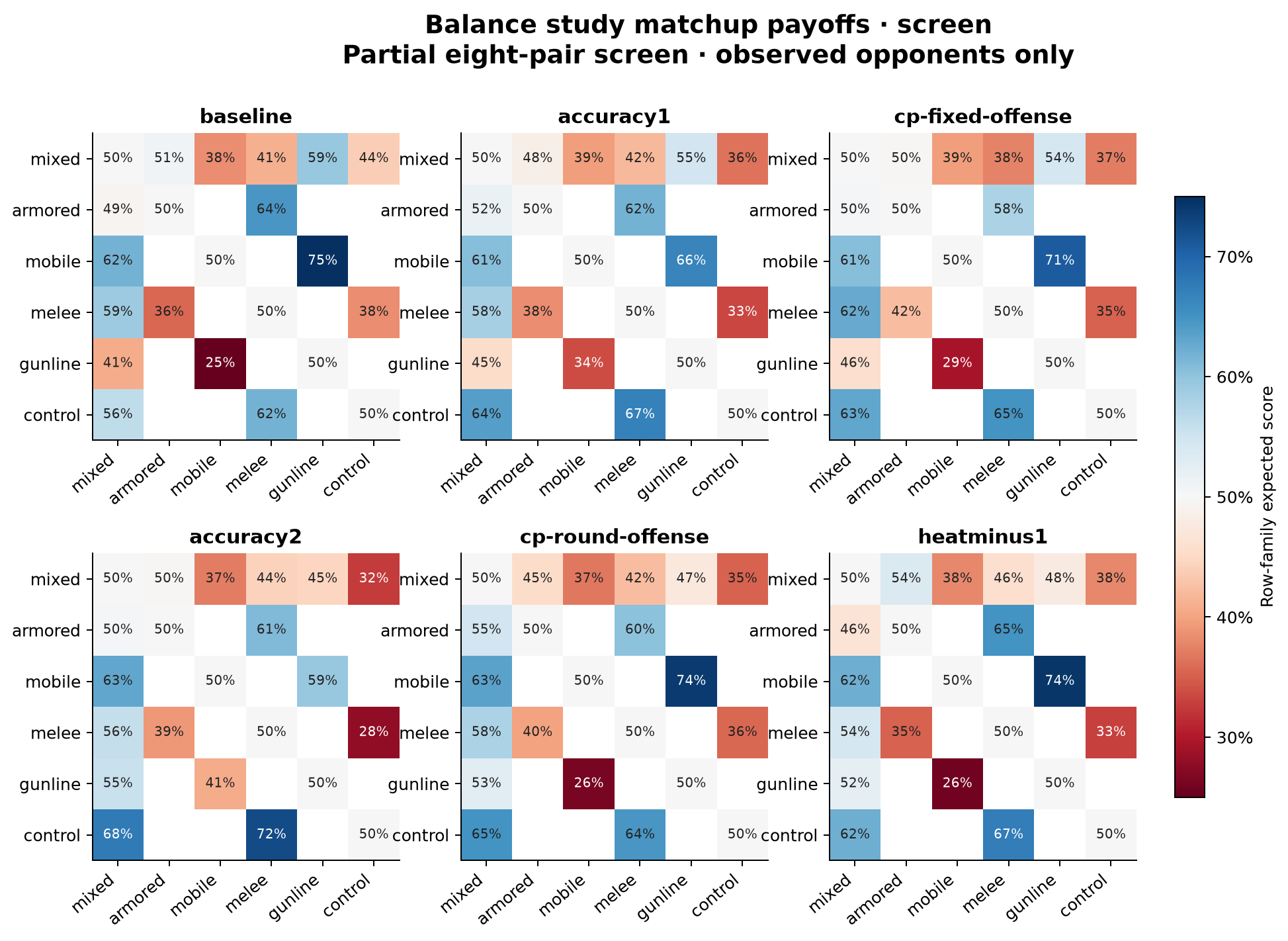
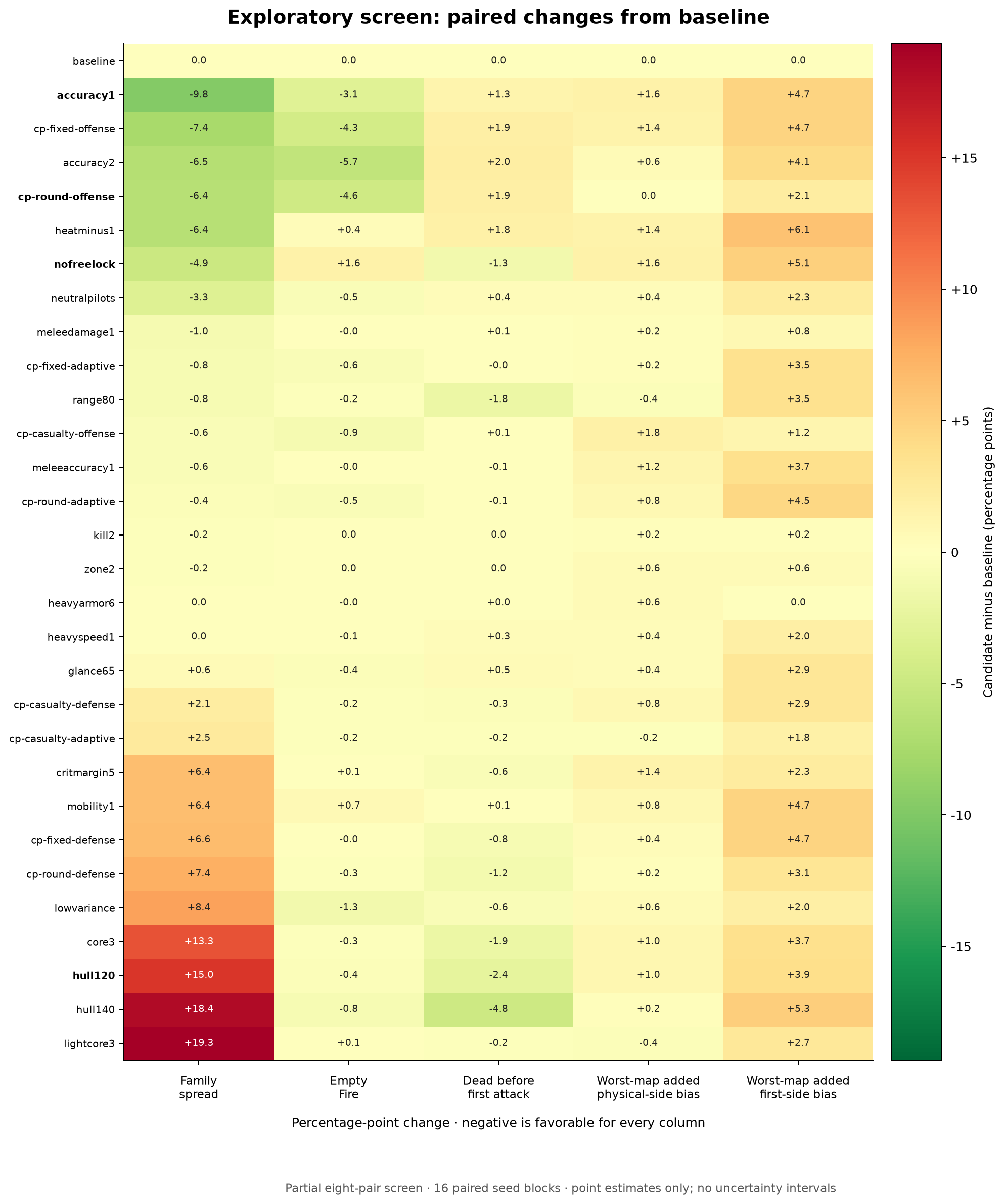
The baseline matrix shows strong matchup dependence, including map-sensitive reversals that the across-map cells conceal. Among the bounded single changes advanced from this screen, accuracy1 reduced observed family spread by 9.8 percentage points and empty Fire by 3.1 points, while raising death before a unit's first attack by 1.3 points and worst-map added first-side bias by 4.7 points. cp-round-offense reduced spread by 6.4 points and empty Fire by 4.6 points, with increases of 1.9 points in early deaths and 2.1 points in worst-map first-side bias. These are promising tradeoffs to test with fresh seeds, not screen-level conclusions.
nofreelock reduced spread by 4.9 points and early deaths by 1.3 points, but increased empty Fire by 1.6 points and worst-map added first-side bias by 5.1 points. hull120 reduced early deaths by 2.4 points and the descriptive wipe rate by 10.5 points, while worsening observed family spread by 15.0 points; it remains useful as a durability interaction control. The corrected goal-path behavior was not part of this 30-condition panel and remains a routing diagnostic for the supplemented stage.
The wider all-pair stage with fresh seeds is needed before selection because it fills the seven unobserved family pairings and can attach exploratory intervals to family payoffs as well as the preregistered paired intervals to the five primary metrics.